The Cost of Silence: Why British Students Are Losing Marks in Seminars and How to Reclaim Them
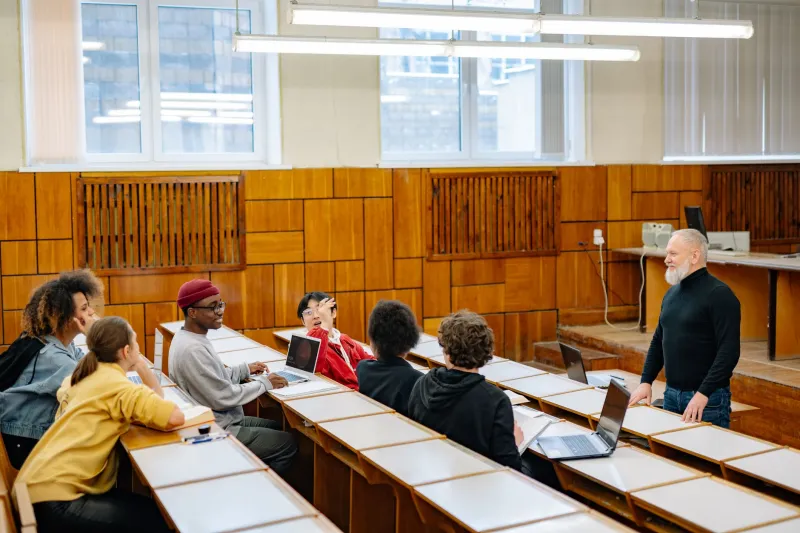
In a seminar room at a British university, a question hangs in the air. The tutor waits. Students stare at their notebooks, examine their laptops, or find sudden fascination in the middle distance. Eventually, after a silence that feels considerably longer than it actually is, someone speaks — often a student for whom English is not a first language, or one who has arrived from an educational culture where vocal participation is expected and rewarded.
This scene is so familiar as to have become almost unremarkable. Yet its consequences are anything but trivial. At many UK institutions, seminar participation carries formal assessment weight — sometimes accounting for ten to twenty per cent of a module grade. Even where it is not explicitly graded, active contribution shapes tutor perception in ways that influence the qualitative feedback students receive on written work. The student who speaks is the student who is seen. And the student who is seen tends to fare better across the board.
Understanding the Roots of British Reticence
To address seminar silence effectively, it is worth understanding why it is so pervasive among domestic UK students specifically. This is not a simple matter of shyness, nor is it adequately explained by introversion alone.
British educational culture carries a powerful — if rarely articulated — suspicion of those who appear to seek attention. Speaking at length in a group setting risks being perceived as self-aggrandising, performative, or, in the particularly damning vernacular of peer culture, a show-off. For many students, the social cost of being seen to try too hard outweighs the academic cost of remaining silent. This calculation is made largely unconsciously, but it is made nonetheless.
There is also a specific intellectual anxiety at play. Many British students operate under the belief that they should only contribute when they are entirely certain their point is correct. Offering a tentative or exploratory observation feels dangerous — an invitation for public correction or, worse, quiet ridicule. This stands in sharp contrast to the norms of many other academic cultures, where thinking aloud is understood as part of the scholarly process rather than evidence of inadequate preparation.
The result is a troubling paradox: students who are intellectually engaged, well-read, and genuinely thoughtful remain silent, while the seminar space is increasingly dominated by peers who are simply more comfortable with the social mechanics of speaking up.
The Participation Criteria Problem
Institutions bear a share of responsibility here. At many UK universities, participation is assessed against criteria that are never made fully explicit. Module handbooks may note that "active engagement in seminars" will be rewarded, but rarely specify what active engagement looks like, how frequently a student is expected to contribute, or what distinguishes a mark-earning comment from a superficial one.
This ambiguity is particularly harmful for students who are already hesitant. Without a clear target, they have no framework for measuring their own performance or setting realistic improvement goals. They may attend every seminar, complete every reading, and feel genuinely invested in the discussion — yet still receive a participation grade that reflects their silence rather than their preparation.
If your module handbook is unclear on this point, it is entirely appropriate — and academically sensible — to ask your tutor directly. Requesting clarification on assessment criteria is not an admission of weakness; it is an exercise of precisely the kind of academic self-advocacy that strong students demonstrate.
The International Student Contrast
The disparity between domestic and international student participation patterns is worth examining honestly. Students arriving from academic cultures in the United States, China, India, or across continental Europe frequently bring different expectations about the role of verbal contribution in learning. For many, speaking in seminars is not merely permitted — it is a core part of how they understand academic engagement to function.
 Photo: United States, via www.mappery.com
This is not to suggest that international students are inherently more intellectually confident. Many face significant linguistic and cultural pressures of their own. However, their willingness to participate — even imperfectly, even tentatively — means they are accumulating both formal marks and informal credibility in the eyes of their tutors. Domestic students who remain silent are, in effect, ceding ground that is theirs to claim.
Practical Strategies for Speaking Up
Overcoming seminar reticence is not a matter of personality transformation. It is a matter of technique, preparation, and incremental exposure. The following approaches are grounded in what actually works.
Prepare one contribution in advance. Before each seminar, identify a single point, question, or observation you are willing to voice. It does not need to be groundbreaking. A well-articulated question about a point from the week's reading is a perfectly legitimate contribution and signals genuine engagement to your tutor.
Speak early. The longer a seminar proceeds without your having spoken, the more psychologically difficult it becomes to break the silence. If you contribute within the first fifteen minutes, you relieve the mounting pressure and find it considerably easier to speak again later.
Reframe contribution as question-asking. If the prospect of making declarative statements feels too exposed, questions are a lower-stakes entry point. Asking for clarification, inviting a peer to expand on their point, or posing a genuine intellectual puzzle to the group are all forms of participation that tutors value highly.
Use the language of uncertainty deliberately. Phrases such as "I'm not sure I've read this correctly, but…" or "I wanted to raise this as a question rather than a claim…" give you permission to think aloud without committing to a position you may not be able to defend. This is not hedging — it is modelling the kind of exploratory intellectual process that seminars are designed to facilitate.
Build relationships outside the seminar room. Students who speak to their tutors during office hours or via email before a seminar often find it easier to contribute during the session itself. Familiarity reduces the social stakes and makes the tutor feel less like an authority figure and more like a conversation partner.
What Is Actually at Stake
Beyond the formal grade implications, seminar participation develops skills that have significant value beyond the university setting: the ability to articulate ideas under mild pressure, to respond to challenge without becoming defensive, and to contribute constructively to a shared intellectual endeavour. These are capabilities that employers, postgraduate admissions panels, and professional environments actively seek.
The student who leaves university having never learned to speak up in a room of peers has missed something that no written assignment can fully replicate. The seminar is not merely an assessment mechanism — it is a rehearsal for professional life. The marks are simply the most immediate reason to take it seriously.